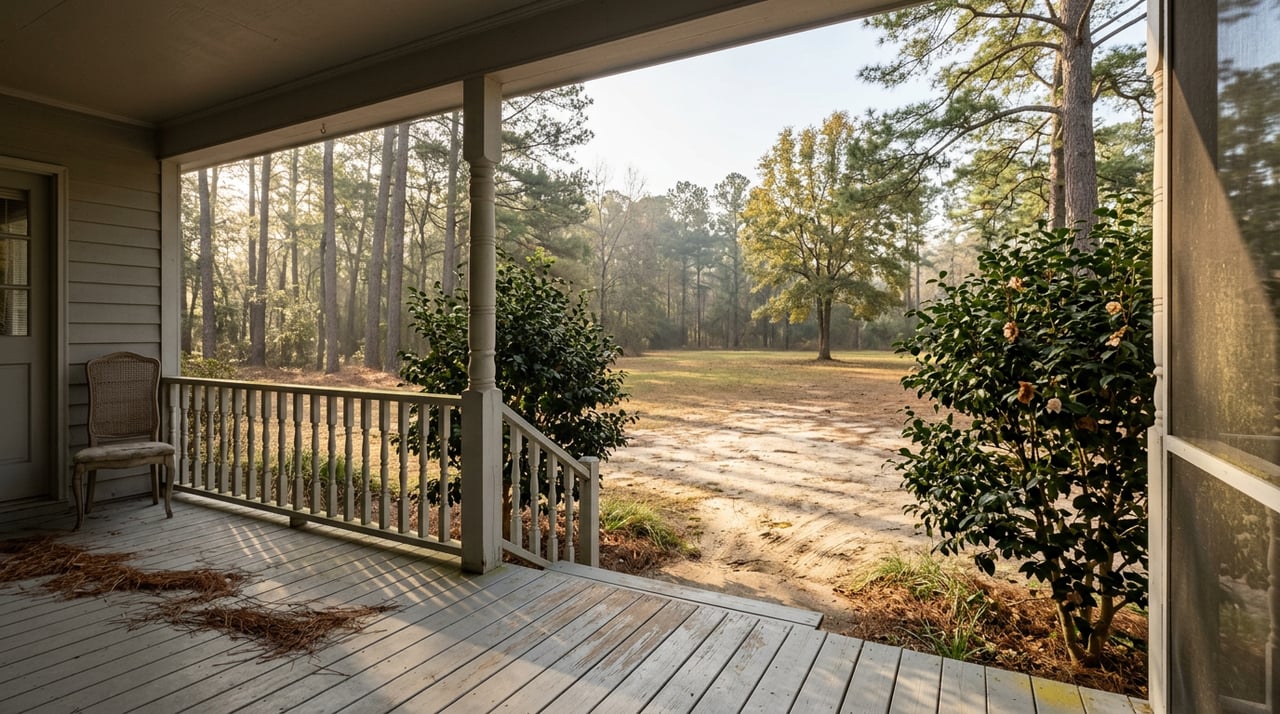
Four miles north of Navarre Beach, off State Road 87 in the community of Holley, there's a patch of land where the clock stops mattering for the better part of a week. Once, sometimes twice a year, a wood-fired kiln there gets loaded with close to a thousand pieces of stoneware, sealed shut, and lit. It runs nonstop for five days. Someone stays awake to feed it the entire time.
That kiln belongs to Holley Hill Pottery, a family studio that has operated on the same stretch of Buckeye Drive since 1980. Most people who drive Highway 98 through Navarre have never heard of it. The people who have tend to talk about it the way you'd talk about a relative's cabin, a place they assume everyone already knows about, until they mention it to someone new and realize they don't.
The number that makes people believers
A WEAR-TV feature that aired this past May profiled the studio and its kilns in detail. The anagama, built in the ancient Japanese wood-firing style, holds close to a thousand pots per load and burns through five cords of wood over five days of continuous firing. Temperatures inside top 2,400 degrees. There's no thermostat to check. The firing is judged by the color of the flame and the instincts of whoever is on shift.
"It takes a good crew of potters," Jason Stokes, the studio's second-generation potter, said in the segment. He described firings that typically draw between thirty and forty volunteer potters, most of them unpaid, showing up to keep a fire going for five straight days.
That's not a casual weekend project. It's also not new. Holley Hill has run this kiln in some form for two decades.
A kiln that predates almost everything else on the block
The anagama at Holley Hill was designed and built in 2004 by wood-fire artist Don Reitz and his former assistant Brian Harper, and it was fired for the first time the following year, according to Ballinger Publishing's history of the Gulf Coast Kiln Walk. It remains one of the largest wood kilns of its kind in the state.
A second kiln on the property tells an even older story. It's a "groundhog" style wood kiln built in the 1940s, discovered abandoned in Jay, Florida, and moved to Holley Hill piece by piece in the mid-2000s. Before it was taken apart, the Stokes family and a crew of volunteers documented every brick so it could be rebuilt exactly as it stood. That kiln once belonged to Ralph Howard Phillips, a Florida folk potter who made jugs, churns, crocks, and garden pottery from local clay. It's still fired today, using the same wood-stoking process he would have recognized.
Neither kiln uses glaze the way most pottery does. Wood ash, oak and pine burned down over days according to Holley Hill's own description of the process, settles on the pots and melts into the surface at those temperatures, leaving marks no two firings ever repeat. Nobody controls exactly where the ash lands or how it flows. That's the point. A studio potter working in an electric kiln can reproduce a glaze recipe on command. A wood-fire potter at Holley Hill can't, even if they wanted to.
Why this counts as community, not just craft
The Stokes family founded the nonprofit Gulf Coast Kiln Walk Society in 2001, specifically because there was no public wood-fire kiln within a twelve-hour radius of the Escambia and Santa Rosa County line. The society exists to keep that kind of firing accessible to anyone who wants to learn it, not just to the family that owns the land.
Getting a load ready isn't a weekend chore. It's closer to a relay:
- Loading the anagama takes about four days on its own, with every pot placed by hand, because each piece affects how ash and heat move around the ones next to it.
- Firing runs another five to six days of round-the-clock monitoring, with a rotating crew keeping watch in shifts.
- Cooling takes up to twelve more days before anyone can open the door and see what actually happened inside.
Jason Stokes described the loading stage to Ballinger Publishing as "a time-consuming process," and it's easy to see why. None of that timeline is possible with three people. It takes a crew willing to lose sleep for something they don't get to keep for themselves.
In the WEAR-TV segment, Brenda Stokes talked about the relationship as a two-way one. Her sense, after nearly five decades of running the studio, is that the community shaped Holley Hill as much as Holley Hill has shaped the community around it. That's not a marketing line. It's closer to a description of how the kiln actually runs. It takes a village literally, not as a figure of speech.
Each February, that crew and the wider public convene for the WoodStoke Pottery and Kiln Festival, a free event where visitors can watch the kilns get unloaded and see what days of fire actually produced. It isn't a curated gallery opening. It's closer to a harvest.
What this actually says about Navarre
Navarre gets described in a lot of the same language as every other stretch of the Emerald Coast: sugar sand, calm water, a quieter alternative to the busier beaches nearby. All of that is true, and none of it explains why a family keeps hand-loading a kiln that takes longer to fire than most vacations last.
The more honest answer is that Navarre's character was never really built by what shows up in a beach guide. It was built by things like this: a kiln that's been burning in the same spot for two decades, using techniques that trace back generations further, run by people who talk about the work as something the community gave them as much as something they gave back. That kind of continuity doesn't market itself well. It doesn't need to. It just keeps firing, once or twice a year, whether anyone's watching or not.
If you've lived in Navarre for a while and never made the drive out to Holley, it's worth doing once, ideally during a firing when smoke is still rising off Buckeye Drive. You'll understand something about this stretch of the Gulf Coast that no visitors guide will tell you.
Details like this rarely show up in a listing description, but they're exactly what shapes how a place actually feels to live in day to day. Whether you already call Navarre home or you're weighing a move to this stretch of the Emerald Coast, Dickson Group is glad to talk through what makes each community here distinct, not just what's currently on the market. Let's Connect.